The Threefold Wisdom of Pendle
There is something deeply evocative about the landscape and the surrounding sacred rivers of Pendle. Pendle Hill. Its distinctive outline, the sweeping Lancashire countryside, and the rivers that carve through the surrounding valleys create a powerful sense of place. For anyone drawn to Celtic spirituality, druidry, shamanism and the wisdom of the natural world, this is a landscape that invites contemplation.
Look more closely, and another pattern emerges: three rivers, three distinct currents, and the possibility of understanding them through the ancient symbolism of threefoldness.
The Hodder, Calder and Ribble each have their own character and journey. Yet, when considered together, they offer a beautiful opportunity to explore three important aspects of spiritual life: remembering, becoming and belonging.
This is the inspiration behind The Sacred Rivers of Pendle, an original Celtic shamanic attunement exploring the relationship between land, water, memory and spirit.
Why is the number three important in Celtic spirituality?
The number three appears repeatedly in Celtic mythology, art, storytelling and religious symbolism. It is one of the most recognisable patterns associated with the ancient Celtic world, although it is important to remember that Celtic cultures were diverse and did not share one single spiritual system.
Threefold patterns can be found in several historical traditions.
In parts of the ancient Celtic world, divine female figures known as the Matres or Matronae were represented in groups of three. These figures, associated with motherhood, fertility and protection, were particularly prominent in Roman-period continental Europe.
In Irish mythology, three names are associated with the sovereignty of Ireland: Ériu, Banba and Fódla. These figures became closely connected with the identity and mythological history of the island.
Welsh literature also contains the Welsh Triads, a medieval collection of traditional material organised into groups of three. These bring together people, events, places and themes from Welsh legendary and historical traditions.
Threefoldness also appears in Celtic-inspired artwork, particularly the familiar triple spiral or triskele. Its precise meanings have varied, and it is best not to assume that every modern interpretation represents an ancient belief.
For contemporary Celtic spirituality, however, threefoldness offers a particularly useful way of exploring relationships, cycles and the interconnected nature of existence.
It can represent beginnings, development and completion; the relationship between past, present and future; or the meeting of different aspects of the natural world.
The important thing is not to impose one fixed interpretation upon the number three, but to explore what its patterns can teach us.
Pendle Hill and the three rivers of Lancashire
Pendle Hill is an unmistakable presence in the Lancashire landscape. Its slopes and surrounding countryside have inspired stories, traditions and folklore for generations.
The wider region is also shaped by its waterways. Three rivers provide the inspiration for this exploration: the Hodder, the Calder and the Ribble.
They do not all rise on Pendle Hill itself. Rather, they belong to the wider landscape of Pendle, Bowland and the Ribble Valley, each following its own geographical course.
The Hodder
The Hodder rises in the upland landscape of the Forest of Bowland and travels through beautiful valleys before joining the Ribble near Great Mitton.
Its journey through woodland, farmland and open countryside makes it particularly evocative of the quieter, less disturbed aspects of the natural world.
The Calder
The Calder has headwaters associated with the Pendle landscape, including Pendle Water, as well as other sources. Its waters come together around Burnley before continuing through the Lancashire landscape towards the Ribble.
It offers a connection with the changing landscape around Pendle and the movement of water through communities and valleys.
The Ribble
The Ribble is the principal river of this wider system. It receives the waters of the Hodder and Calder, among numerous other tributaries, before continuing towards the Irish Sea.
Its broader course offers a powerful image of connection, gathering and onward movement.
These rivers are geographically distinct, but together they provide a meaningful spiritual framework for exploring the relationship between the individual and the greater whole.
The three sacred currents: Remembering, Becoming and Belonging
Within The Sacred Rivers of Pendle, each river has been given a contemporary spiritual correspondence. These are original interpretations developed for this spiritual energy system, inspired by the character of the landscape and the symbolism of Celtic threefoldness.
1. The Hodder: Remembering
The first current is that of remembering.
The Hodder represents our relationship with ancestry, roots, personal history and the natural wisdom that comes through observation and experience.
Remembering is not simply about looking backwards. It is about recognising the experiences, relationships and influences that have helped shape us.
It invites us to consider our connection with the generations who came before us, the places that have influenced our lives and the lessons we have gathered along the way.
In Celtic shamanic practice, developing a relationship with the land can encourage a deeper appreciation of our place within the natural world.
The Hodder offers a reminder:
Remember where you come from.
Its associated colour is deep woodland green, representing roots, growth, nature and continuity.
2. The Calder: Becoming
The second current is that of becoming.
The Calder represents movement, transformation and the courage to change direction.
Water rarely remains still. It moves around obstacles, finds new channels and continues its journey. This provides a useful image for our own lives.
There are times when we need to reconsider our direction, release old habits or recognise that the person we once were is not necessarily the person we are becoming.
Transformation does not always involve dramatic change. Sometimes it begins with a small decision, a new understanding or the willingness to see an old situation differently.
The Calder offers a reminder:
Become who you are capable of being.
Its associated colour is warm amber, representing transformation, inner strength, movement and the light of new possibilities.
3. The Ribble: Belonging
The third current is that of belonging.
The Ribble represents connection, unity and our relationship with the wider web of life.
Its journey brings together the waters of numerous tributaries. In this way, it provides a natural image of how individual lives, experiences and relationships contribute to something greater.
Belonging is about recognising that we are not isolated from the world around us. We are connected to other people, the natural environment and the places that give our lives meaning.
It also invites us to consider how we contribute to the world in which we live.
The Ribble offers a reminder:
You are part of something greater than yourself.
Its associated colour is clear river blue, representing connection, openness, harmony and the wider flow of life.
The three colours of spiritual energy
The three river correspondences can also be explored through colour.
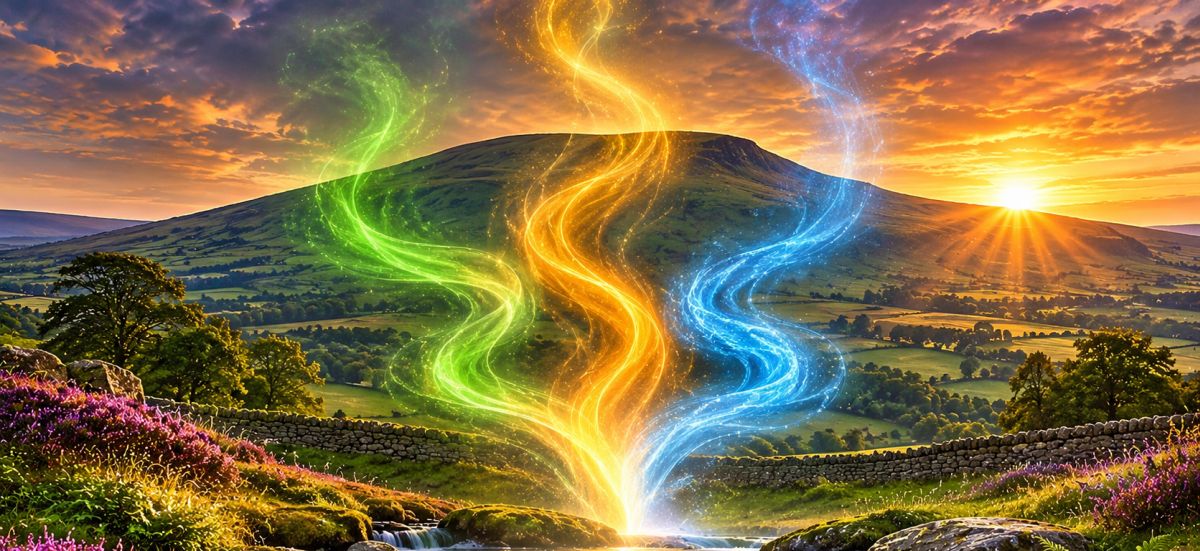
Imagine three distinct streams of energy moving through the landscape:
- Green, the Hodder, representing remembering, roots and ancestral awareness.
- Amber, the Calder, representing becoming, transformation and personal growth.
- Blue, the Ribble, representing belonging, connection and unity.
At first, these colours remain separate, each with its own character and quality.
Then, gradually, they begin to move towards one another.
The three streams meet, intertwine and become a single flowing current.
This is the central image of the Three Sacred Waters: not the loss of individuality, but the recognition that different experiences and qualities can exist together as part of a greater whole.
Our memories help shape us. Our willingness to change allows us to grow. Our relationships and connections remind us that we belong.
Remembering. Becoming. Belonging.
Three currents, one journey.
The spiritual significance of the land
For me, Celtic shamanism and druidism are rooted in relationship: our relationship with the land, the natural world, the unseen dimensions of existence and the experiences that shape our spiritual development.
A hill is more than a geographical feature when we begin to develop a meaningful relationship with its landscape. A river can become a source of reflection, inspiration and spiritual symbolism. A woodland, a standing stone or an ancient path can encourage us to slow down and pay attention.
This does not require us to claim that every natural feature was once the centre of an ancient religious practice.
There is value in allowing the landscape to inspire new spiritual understanding while respecting what history can and cannot tell us.
Pendle has its own rich history and folklore, including the tragic events of the Lancashire witch trials of 1612. Its history deserves to be approached with sensitivity and respect. The spiritual work described here is not an attempt to attribute these modern river teachings to the people who lived through those events.
Instead, it is an opportunity to develop a contemporary relationship with this remarkable part of Lancashire.
The Sacred Rivers of Pendle: A Celtic shamanic attunement
The three river currents have inspired me to create The Sacred Rivers of Pendle, an original distance attunement bringing together the symbolism of the Hodder, Calder and Ribble.
It is designed as a spiritual journey through three interconnected teachings.
Through the Hodder, we explore remembering and our connection with the past.
Through the Calder, we explore becoming and the possibility of transformation.
Through the Ribble, we explore belonging and our relationship with the wider living world.
The journey then brings these three currents together as one.
The attunement includes a guided meditation inspired by the spirit of Old Pendle, allowing participants to imagine themselves within the Lancashire landscape and reflect upon the relationship between hill, river and spirit.
You do not need to visit Pendle or live in Lancashire to take part. The attunement is offered at a distance, allowing you to undertake the experience wherever you are.
Three rivers, three teachings, one journey
Perhaps the most valuable lesson to take from the three rivers is that our lives are not defined by one experience or one moment in time.
We carry our memories, but we are not limited by them.
We continue to change, learn and develop.
And throughout our journey, we remain connected to the people, places and natural world around us.
The landscape of Pendle and Bowland provides a beautiful setting for contemplating these ideas. The Hodder, Calder and Ribble offer three distinct images through which to explore them.
Remembering. Becoming. Belonging.
Three currents of the spirit, inspired by my ancestors and the living landscape of Lancashire.